Uber Med
Reducing missed medical appointments by integrating healthcare scheduling with reliable transportation.

Role:
Product Designer
Team:
Just me!
Tools:
Figma
Timeline: Jan - March 2026
The Problem
For 5.8 millions of Americans, transportation is a major barrier to accessing healthcare.
This is due to a lack of reliable transportation, delays in arrival time, poor location accuracy, and limited coordination between healthcare systems and rides. So, to tackle this gap:
The Solution
How might we enable Uber patients with physical and cognitive barriers to reach their healthcare appointments on time with personalized support?
My concept: Uber Med introduces three core changes to how Uber handles medical rides, each targeting a distinct point of friction in the patient's journey to care.
My answer: Uber Med introduces three core changes to how Uber handles medical rides, each targeting a distinct point of friction in the patient's journey.
Clinic-Level Drop-off
Pinpoints the exact entrance or department, rather than a generic address or main entrance.

Appointment Sync Timing
Calculates departure time based on appointment start, factoring in travel and check-in.
Ride Accommodations
Surfaces accessibility and medical preferences at the point of booking.
Research
Surveys & Interviews
To understand the real friction patients face, I surveyed and interviewed 30 people about their experiences getting to medical appointments:
60%
of respondents have missed, been late to, or rescheduled a medical appointment due to transportation issues
21
/30
were uncertain about their arrival time
19
/30
struggled to find the correct entrance or building
16
/30
struggled to communicate with a driver
Social Listening
To supplement the above, I conducted secondary research by analyzing Reddit threads and App Store reviews to understand how real Uber Health users describe their experiences. Here's what stood out:


Market Analysis

Uber (General)

NEMT Services

Lyft Healthcare

Uber Health

Overall, we see that the current market lacks a patient-facing solution that balances on-demand rides with medical context. This gap becomes the opportunity! Now, to synthesize data into designs…
Design Process
Key Insights
Patients need clear handoffs with drivers
Timing and accessibility needs are often unmet.
Correct arrival location is critical.
Need clear patient-driver handoff
Unmet timing and accessibility needs
Correct arrival location is critical.

Core Design
Direct patient-facing flow
Clinic-specific drop off & time estimation
Personalized ride accessibility
Constraints & Tradeoffs
Considered
Decision
Considered vs. Decision
1
EHR integration vs. manual appointment entry
→
Manual entry to ship without hospital API dependency
2
Full accessibility vs. simplified ride preferences
→
Key accommodations without requiring medical history
3
Provider HIPAA vs. patient access
→
Extended existing infrastructure to give patients control
EHR integration vs. manual appointment entry → manual entry to ship without hospital API dependency
Full accessibility vs. simplified ride preferences → key accommodations without requiring medical history
Provider-side HIPAA vs. patient-facing access→ extended existing infrastructure to put patients in control
Hi-fi Flow Adjustments
Hi-fi Flow Adjustments
I decided to keep Uber Med within the existing ride selection flow rather than a standalone product, triggered by destination type and appointment time (not a separate entry point). This distinguishes timing from accommodation needs, while also reducing decision fatigue at the start of the flow.

Users select hospital and appointment date & time

Uber Med surfaces as the recommended ride
User Feedback & Iterations
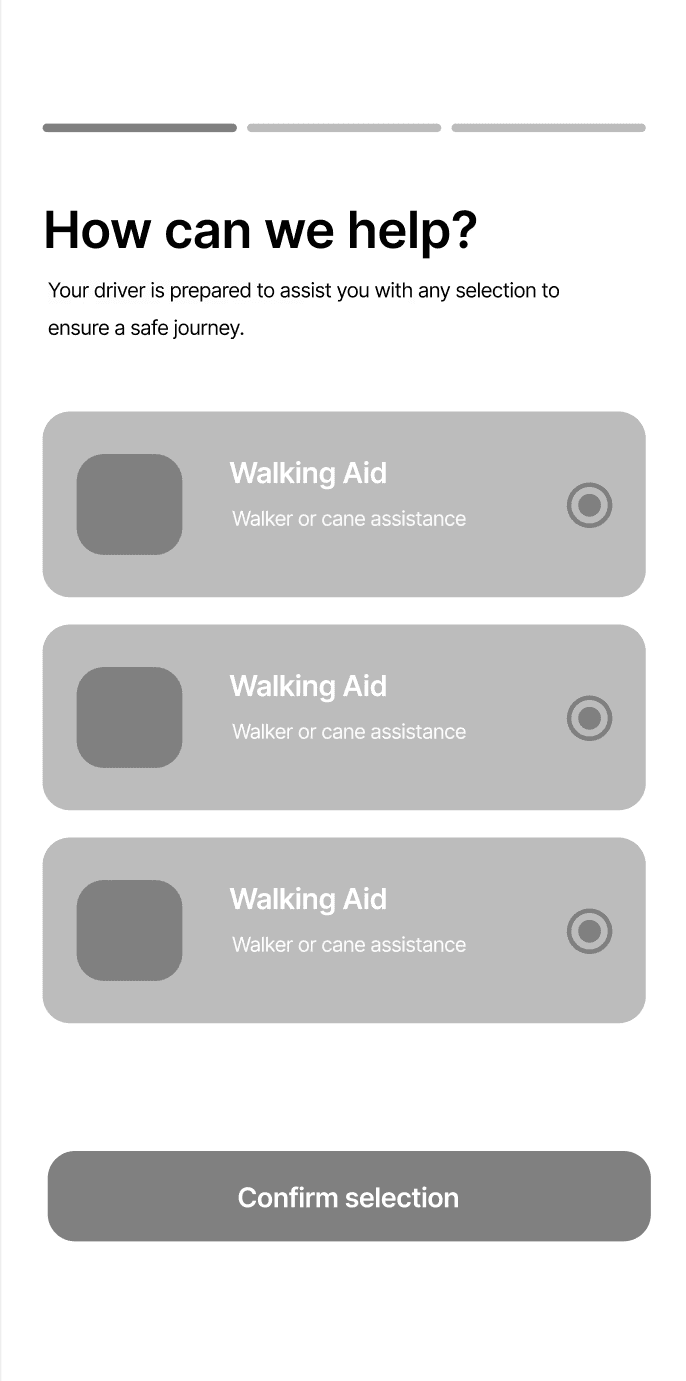
Needs a confirmation or review page
Circles seem more like a single-selection format
Needs more visual unity between options
Missing "back" or "return" option
The purpose of this step-by-step is unclear


Clear step-by-step segmentation for organized decision making

Review screen for appointment time, pickup info, accommodations
Key Takeaways!
This project reinforced the importance of grounding product decisions in research. It also highlighted the value of designing within Uber's existing constraints, leveraging existing ride and scheduling flows rather than reinventing them.
This project reinforced the importance of grounding product decisions in research. It also highlighted the value of designing within Uber's existing constraints, leveraging existing flows rather than reinventing them.
What's Next
With more time, I'd extend usability testing across broader patient groups and explore pushing the design beyond the ride, particularly the post-arrival experience—guiding patients from drop-off to the correct entrance or department!
Disclaimer: This was a concept project (not affiliated with Uber)!
Onto the next?

Uber Med
Reducing missed medical appointments by integrating healthcare scheduling with reliable transportation.
Team:
Just me!
Role:
Product Designer
Tools:
Figma
Timeline: Jan - Mar '26
The Problem
For 5.8 millions of Americans, transportation is a major barrier to accessing healthcare.
This is due to a lack of reliable transportation, arrival delays, poor location accuracy, and little coordination between healthcare systems and rides. So, to tackle this gap:
The Solution
How might we enable Uber patients with physical and cognitive barriers to reach their healthcare appointments on time with personalized support?
My answer: Uber Med introduces three core changes to how Uber handles medical rides, each targeting a distinct point of friction in the patient's journey.
Clinic-Level Drop-off
Pinpoints the exact entrance or department, rather than a generic address or main entrance.
Appointment Sync Timing
Calculates departure time based on appointment start, factoring in travel and check-in.
Ride Accommodations
Surfaces accessibility and medical preferences at the point of booking.
Research
Surveys & Interviews
To understand the real friction patients face, I surveyed and interviewed 30 people about their experiences getting to medical appointments:
60%
of respondents have missed, been late to, or rescheduled a medical appointment due to transportation issues
21
/30
were uncertain about their arrival time
19
/30
struggled to find the correct entrance or building
16
/30
struggled to communicate with a driver
Social Listening
To supplement the above, I conducted secondary research by analyzing Reddit threads and App Store reviews to understand how real Uber Health users describe their experiences. Here's what stood out:
Market Analysis
Uber (General)
NEMT Services
Lyft Healthcare
Uber Health
Overall, we see that the current market lacks a patient-facing solution that balances on-demand rides with medical context. This gap becomes the opportunity! Now, to synthesize data into designs…
Design Process
Key Insights
Need clear patient-driver handoff
Unmet timing & accessibility needs
Correct arrival location is critical
Core Design
Direct patient-facing flow
Clinic drop off & time estimation
Personalized ride accessibility
Constraints & Tradeoffs
Considered vs. Decision
1
EHR integration vs. manual appointment entry
→
Manual entry to ship without hospital API dependency
2
Full accessibility vs. simplified ride preferences
→
Key accommodations without requiring medical history
3
Provider HIPAA vs. patient access
→
Extended existing infrastructure to give patients control
Hi-fi Flow Adjustments
I decided to keep Uber Med within the existing ride selection flow rather than a standalone product, triggered by destination type and appointment time (not a separate entry point). This distinguishes timing from accommodation needs, while also reducing decision fatigue at the start of the flow.

Users select hospital and appointment date & time

Uber Med surfaces as the recommended ride
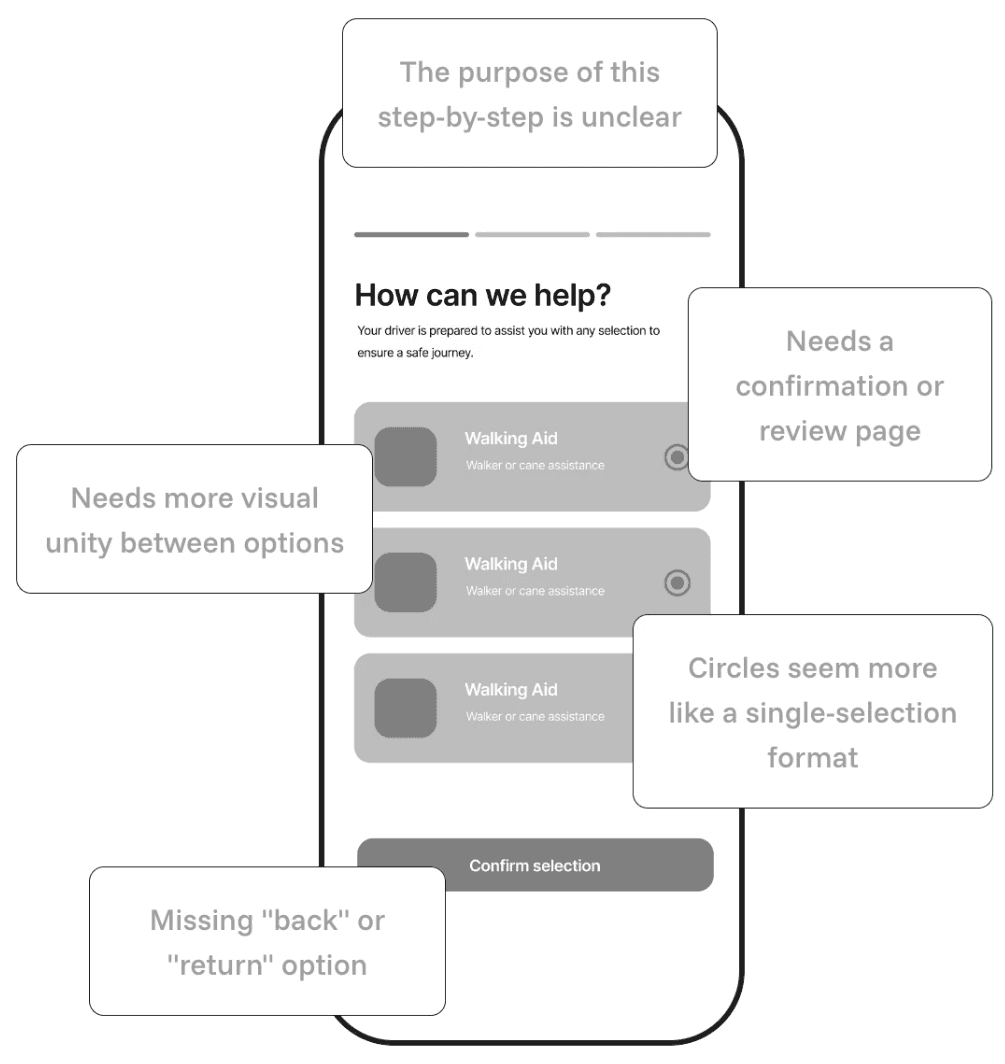
User Feedback & Iterations
Key Takeaways!
This project reinforced the importance of grounding product decisions in research. It also highlighted the value of designing within Uber's existing constraints, leveraging existing ride and scheduling flows rather than reinventing them.
What's Next
With more time, I'd extend usability testing across broader patient groups and push the design beyond the ride, particularly the post-arrival experience—guiding patients from drop-off to the correct entrance or department!